

The silent progression of severe chronic liver disease
MASH (metabolic dysfunction–associated steatohepatitis) is a severe form of liver disease that involves liver inflammation and fibrosis. If untreated, MASH can lead to cirrhosis, liver cancer, and liver failure. Previously, this condition was labeled NASH (nonalcoholic steatohepatitis) (1, 2). MASLD (metabolic dysfunction–associated steatotic liver disease) is another fatty liver condition and a precursor to MASH, found to be associated with numerous cardiometabolic risk factors (1).
Fibrosis, not symptoms, is the key factor in MASH progression and the strongest predictor of long-term outcomes, including comorbid complications and mortality (3). MASH often presents with nonspecific symptoms, and may progress undetected or silently. Distinct symptoms may not appear until the development of advanced fibrosis, indicating a need to identify MASH in early stages (4, 5).
Incidence of MASH and corresponding comorbidities: A rising global concern
MASH-induced cirrhosis is considered one of the fastest-growing liver diseases (6). In the United States and globally, rising rates of obesity, diabetes, and other metabolic disorders underlie an increase in MASLD and MASH, creating a growing population at risk for silent disease progression without proactive identification (4). For patients, the impact of late diagnosis is high, with nearly 70% of patients being unaware that they had preexisting liver disease at the time of their cirrhosis diagnosis (7). Given the newly approved therapies for patients with MASH and increased clinical trial focus, identifying patients whose disease is likely to progress is of increasing importance.
Cardiovascular and cardiometabolic conditions are prevalent among patients with MASH (5). Studies have shown a significantly higher incidence of cardiometabolic comorbidities among patients with MASH progression, including type 2 diabetes, hypertension, cardiovascular disease (CVD), and cardiovascular events. Cardiometabolic comorbidities are also increased in patients with MASH with more advanced fibrosis or cirrhosis (4), and MASH hospitalizations associated with CVD incur a higher financial burden (5).
There is greater risk of mortality in MASH due to CVD, cardiovascular events, and metabolic comorbidities. CVD is recognized as a leading cause of death among patients with MASH (4, 5). Given this, patients presenting with these metabolic and cardiometabolic syndromes should be proactively screened for liver disease. Increased risk of progression to clinical outcomes and mortality due to advancing fibrosis and development of cirrhosis underscores the need for early MASH detection and therapeutic intervention, to slow, stop, or reverse fibrosis before irreversible liver damage occurs, and for prevention of the comorbidities associated with late-stage liver disease (4, 5).
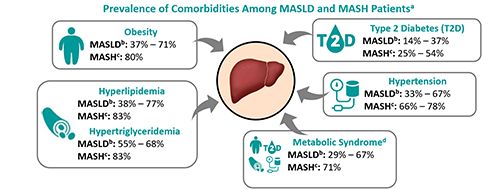
Figure 1. Prevalence of comorbidities among MASLD and MASH patients. aData rounded to nearest whole percentage. bRanges reflect various collection methods, which can include self-reporting, blood test, imaging, ICD code, and a mixture of methods and include North American data only. cData from biopsied patients. dMetabolic syndrome is a group of conditions including obesity, hypertension, insulin resistance, and dyslipidemia (7).
Although the prevalence of MASH is rising, it remains largely undiagnosed
Various factors contribute to delayed diagnosis, including knowledge gaps, silent progression and lack of overt symptoms, biopsy challenges, and historically limited treatment options (8-11). Cirrhosis is therefore frequently diagnosed incidentally, leaving most patients unaware of their underlying liver disease and receiving no actual diagnosis and treatment until complications arise (8, 12).
Delays in detection decrease the opportunity to initiate treatment and change disease course. Once cirrhosis has developed, there are limited treatment options and an increase in disease-related complications. Use of healthcare resources and the cost of care also increase. As fibrosis advances, risks increase not just for cirrhosis and liver failure but for serious systemic outcomes, including CVD, chronic kidney disease, hepatocellular carcinoma, depression, fatigue, and mortality. With advanced fibrosis, patients also experience a significant decrease in health-related quality of life (2).
Greater reliance on noninvasive testing, including the ELF® Test, will require increased processing in centralized laboratories
As MASH is often asymptomatic, it is frequently diagnosed during assessments of other conditions. Upon suspicion of MASH, invasive liver biopsy is the conclusive diagnostic tool. This procedure carries risk of complications, is painful, requires trained personnel, and may incur high financial cost to the patient. Given this, noninvasive tests (NITs) are increasingly replacing liver biopsy for MASH diagnosis (11, 13, 14).
Several NITs are currently available, including blood tests for biomarkers, imaging techniques, elastography, and predictive models (14, 15). Noninvasive tools such as imaging evaluate liver stiffness, which increases with advancing disease severity and fibrosis (14, 16). Techniques include vibration-controlled transient elastography (VCTE) and ultrasound-based methods such as acoustic radio force impulse (ARFI). If available, these are favorable assessments to use in the primary care setting (16). However, these tests are not always readily available, are costly, and may vary regarding ease of use, accuracy, and sensitivity in evaluating degree of liver fibrosis (15, 16).
Serum-based tests measuring specific biomarkers are noninvasive options. These tests can be utilized for initial assessment and also are a good alternative option when imaging is not available (14, 15). These methods evaluate the risk of advanced fibrosis in patients with MASH and are more cost-effective and accessible than imaging and elastography (14, 16). Calculated blood-based scores and serum biomarkers include nonproprietary tests such as the Fibrosis-4 (FIB-4) score, NAFLD Fibrosis Score (NFS), and aminotransferase-to-platelet index (APRI) (16). The Enhanced Liver Fibrosis (ELF) Test is also a serum-based test and is unique in that it is authorized for prognostic assessment of risk of disease progression in patients with advanced fibrosis due to MASH.
ELF is a prognostic test that measures biomarkers involved in extracellular matrix turnover during fibrogenesis: tissue inhibitor of matrix metalloproteinase-1, hyaluronic acid, and amino-terminal propeptide of type III procollagen. The ELF Test measures direct markers of fibrosis, as contrasted with FIB-4 and NFS, which assess indirect markers of liver function and injury (15). For patients with advanced fibrosis due to MASH, the ELF Test can assess likelihood of progression to cirrhosis and liver-related events (17).
In this evolving care model utilizing ELF, laboratories play a critical role in providing reliable prognostic information in patients with MASH. Laboratory tests are a crucial first step in the development of a care team, providing a clear picture of the degree of fibrosis, and for a prognostic test like ELF, prediction of risk for disease progression. Furthermore, initial noninvasive laboratory testing at point-of-care reduces the need for advanced testing equipment, such as imaging and elastography devices (14). Biomarker tests, including ELF, have demonstrated further advantages of ease of use and laboratory reproducibility in addition to their broad availability.
Summary
In the continuum of progressive liver disease, MASH is a severe disease state characterized by inflammation and fibrosis, which is the key predictor of disease outcomes. Fibrosis in MASH often progresses silently, delaying detection and treatment. MASH carries a high burden of comorbidities, and if untreated leads to further morbidity and mortality. The ELF Test can help assess risk of disease progression before complications arise and potentially prevent or delay advancement to cirrhosis and comorbid complications. Laboratory testing with ELF has been shown to be highly predictive of risk of disease progression and helps patients avoid the risks, pain, and costs of liver biopsy.
References
- Rinella ME, Lazarus JV, Ratziu V, et al; for the NAFLD Nomenclature consensus group. A multisociety Delphi consensus statement on new fatty liver disease nomenclature. Hepatology 2023;78:1966-86.
- Younossi ZM, Kalligeros M, Henry L. Epidemiology of metabolic dysfunction–associated steatotic liver disease. Clin Mol Hepatol 2025;31(suppl):S32-50.
- Younossi ZM, Stepanova M, Rafiq N, et al. Pathologic criteria for nonalcoholic steatohepatitis: Interprotocol agreement and ability to predict liver-related mortality. Hepatology 2011;53:1874-82.
- Luthra R, Sheth A. Understanding MASH: An examination of progression and clinical outcomes by disease severity in the TARGET-NASH database. Adv Ther 2025;42:1165-95.
- Povsic M, Wong OY, Perry R, et al. A structured literature review of the epidemiology and disease burden of non-alcoholic steatohepatitis (NASH). Adv Ther 2019;36:1574-94.
- Peng C, Stewart AG, Woodman OL, et al. Non-alcoholic steatohepatitis: A review of its mechanism, models and medical treatments. Front Pharmacol 2020;11:603926.
- Younossi ZM, Koenig AB, Abdelatif D, et al. Global epidemiology of nonalcoholic fatty liver disease—meta-analytic assessment of prevalence, incidence, and outcomes. Hepatology 2016;64:73-84.
- Premkumar M, Anand AC. Overview of complications in cirrhosis. J Clin Exp Hepatol 2022;12:1150-74.
- Eskridge W, Cryer DR, Schattenberg JM, et al. Metabolic dysfunction–associated steatotic liver disease and metabolic dysfunction–associated steatohepatitis: The patient and physician perspective. J Clin Med 2023;12:6216.
- Allen AM, Hoovler AR, Articolo A, et al. Gaps in MASLD/MASH education: A quantitative and qualitative survey with leaders of US graduate medical education programs. Adv Med Educ Pract 2025;16:729-48.
- Nallagangula KS, Nagaraj SK, Venkataswamy L, et al. Liver fibrosis: A compilation on the biomarkers status and their significance during disease progression. Future Sci OA 2017;4:FSO250.
- Wong RJ, Kachru N, Martinez DJ, et al. Real-world comorbidity burden, health care utilization, and costs of nonalcoholic steatohepatitis patients with advanced liver diseases. J Clin Gastroenterol 2021;55:891-902.
- Gbadamosi SO, Evans KA, Brady BL, et al. Noninvasive tests and diagnostic pathways to MASH diagnosis in the United States: A retrospective observational study. J Med Econ 2025;28:314-22.
- Tantu MT, Farhana FZ, Haque F, et al. Pathophysiology, noninvasive diagnostics and emerging personalized treatments for metabolic associated liver diseases. NPJ Gut Liver 2025;2:18.
- Dawod S, Brown K. Non-invasive testing in metabolic dysfunction–associated steatotic liver disease. Front Med (Lausanne) 2024;11:1499013.
- Rinella ME, Neuschwander-Tetri BA, Siddiqui MS, et al. AASLD Practice Guidance on the clinical assessment and management of nonalcoholic fatty liver disease. Hepatology 2023;77:1797-1835.
- Siemens Healthineers. Enhanced Liver Fibrosis (ELF™) Instructions for Use. February 2024.
Sponsored and organized by