

There are many good reasons to transition to a new laboratory information system (LIS), especially when doing so is partnered and aligned with implementing a new clinical information system (CIS). In making this shift, clinical labs move away from fragmented patient information and healthcare workflows and toward centralized access to health information and best practices for all who connect with the new system.
But that does not mean the process comes without risks and obstacles. Indeed, such a transition raises numerous challenges related to standardization, testing, available resources, and other factors — all of which must be navigated with care.
To help others learn from our experience, this article highlights our implementation of a CIS and LIS after the formation of a health system in Alberta, a province within Canada that spans over 25,000 square miles. At the time of full implementation, Alberta Health Services (AHS) operated 106 acute care facilities and offered programs and services at more than 900 facilities throughout the province, including hospitals, continuing care facilities, cancer centers, and community health sites.
Before our CIS and LIS transition began, AHS had more than 1,300 independent health information systems, including five legacy lab information systems. During our journey of implementation, lab services moved from six clinical lab providers to two, and finally from two providers into a single lab provider for all of Alberta. Through a competitive process, Epic Systems Corporation was selected as the CIS for all health disciplines across the province, and Epic Beaker became the LIS.
To bring in one LIS across the province, all healthcare teams involved in the implementation agreed to multiple guiding principles (1), which helped to minimize conflict and maximize benefits. Some examples of principles that resonated from the clinical laboratory perspective included: putting patients and families first, moving fast, avoiding unhelpful variation, and using tools for transformation.
By prioritizing patients and families, the stakeholders maintained a strong focus on safety and augmenting the healthcare experience. Additionally, their commitment to making quick, clear decisions throughout the journey helped them keep up with steep timelines. Minimizing variation and including evidence-based guidance helped prevent unnecessarily complex builds and workflows. Finally, by focusing on transformation as the new technology came to fruition, the team stepped away from old inefficiencies and embraced a more streamlined approach.
Implementation
Implementing an integrated information system in laboratory services was a complex, multiphase process that required careful planning, coordination, and execution. This project introduced a unified platform for laboratory ordering, specimen tracking, results reporting, and integration with the CIS. It required substantial technical, operational, and organizational changes to the lab environment.
As a first step, subject matter experts (SMEs), including medical and scientific staff as well as laboratory technologists from across Alberta, conducted a detailed planning and workflow analysis. During this multiyear operation, they mapped existing laboratory processes to identify current workflows, system dependencies, and variations across sites. This analysis informed the design of future workflows aligned with LIS functionality. Key implementation decisions included test menu configuration, result component structure, incorporation of test utilization measures, and alignment with provincial standards and guiding principles. Stakeholder engagement ensured that laboratory requirements were accurately captured and incorporated.
System build and configuration — major components of implementation — involved configuring the LIS to include all laboratory tests, panels, reflex rules, reportable ranges, reference intervals, critical values, and specimen requirements, and then developing and validating interfaces between the LIS, middleware, and laboratory instruments to support bidirectional data flow. Accomplishing this required close collaboration between laboratory informatics teams, IT specialists, vendors, and operational leadership to ensure both technical accuracy and operational feasibility. These professionals also worked together to check, update, and/or replace associated devices, such as computers, printers, and mobile devices.
System testing also played a critical role. This included the testing of individual test builds, interfaces, and laboratory workflows, and end-to-end validation from order entry through result reporting. Frontline laboratory staff and SMEs conducted user acceptance testing to simulate real-world scenarios and confirm system readiness. The issues they identified during testing were documented and resolved prior to the go-live phase, with repeated testing done as necessary.
Training and readiness activities were carried out concurrently with system build and testing. Laboratory staff received role-based training tailored to their responsibilities, including specimen collection and processing, analytical workflows, result verification, and reporting. Training methods included instructor-led classroom sessions, e-learning modules, and hands-on practice in training environments. “Super users” were identified and trained in advance to provide expertise and support local implementation. In parallel, SMEs and trainers collaboratively developed standard operating procedures and tipsheets to ensure consistency in daily operations and maintain the quality of laboratory services during and after the transition.
The go-live phase required extensive coordination and operational planning among stakeholders to support the new LIS and CIS. Additional support structures were established, including command centers, on-site support personnel, and dedicated help desks. Laboratory workflows were closely monitored to identify and address issues in real time, ensuring continuity of services as best as possible during the transition.
Altogether, the implementation took 5 years and proceeded through nine phases (launches). The initial launch began in November 2019 and encompassed multiple sites, including one entire hospital, one separate hospital laboratory, one community hub laboratory, and multiple patient-collection sites. The project team collected feedback during early phases to identify areas that required adjustment during later launches. Subsequent phases were rolled out progressively across the province, with increasing efficiency and fewer reported issues at each stage.
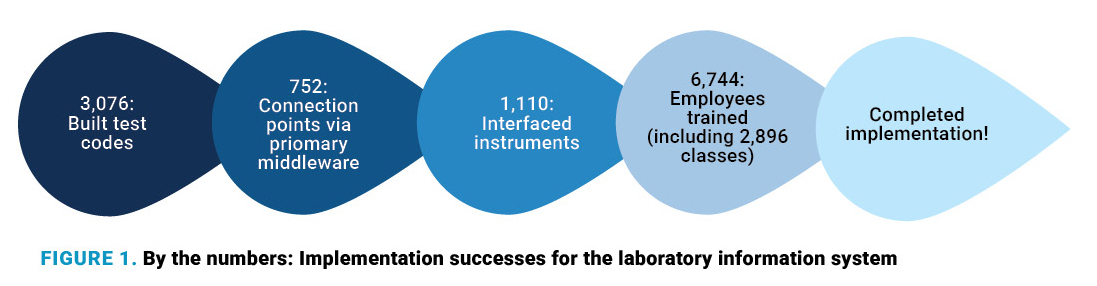
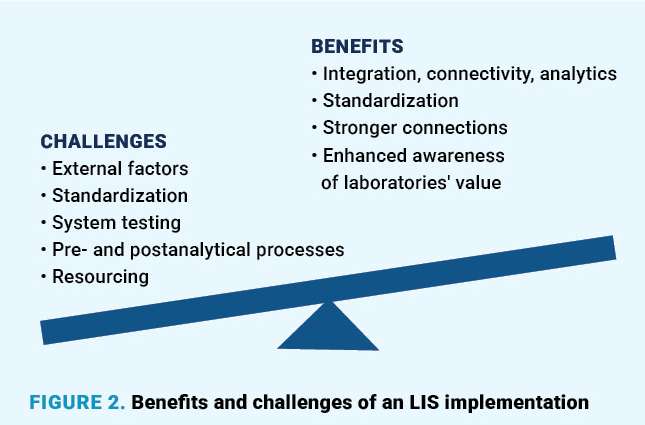
By the time the whole implementation was complete, many notable feats had been achieved (Figure 1). Full provincial implementation was completed in November 2024. We identified many challenges and benefits along the way, as we describe here and summarize in Figure 2.
Challenges
External factors
After the first implementation phase was finished in November 2019, the second phase was slated for completion within 6 months. However, the COVID-19 pandemic shifted priorities and focus within the health system and delayed the second phase by approximately 6 months. Although this turn of events provided additional time for system build and preparation, it unexpectedly prolonged an interim state in which multiple LISs coexisted within the same geographical health region, which proved challenging to manage and confusing for frontline staff.
The laboratory network also experienced several major organizational changes and health system transformations over the 5-year implementation period. These shifts led to changes in leadership and evolving expectations and responsibilities, requiring staff to adapt to new organizational structures. The resulting uncertainty and competing demands diverted limited resources away from this major project and toward immediate priorities.
Standardization
Standardization becomes increasingly difficult as the scope of an initiative expands. Although a single hospital can align workflows and systems relatively easily, scaling processes across the province required the project leaders to address widespread variability in instrumentation, workflows and processes, and clinical and laboratory practices.
Achieving optimal standardization is a balancing act. Failing to address standardization can lead to inconsistencies that can affect the quality, clarity, and comparability of results, while focusing too heavily on it can result in reduced flexibility to individual sites, the loss of valuable local practices, and increased resistance to change among healthcare teams. Strong governance is the key to navigating these issues, so laboratory and clinical stakeholders can carefully weigh local needs against system-wide consistency.
System testing
System testing at each site was very valuable to identify errors and gaps that could have led to unexpected surprises after go-live. Although it consumed extensive resources and time, comprehensive testing was needed to provide a comfort level for medical and operational SMEs for signoff.
That said, in hindsight, we believe some of the testing plans were excessive for new sites and instruments. Once we developed a better understanding of the system’s capability, we adopted a more streamlined approach in later launches. For example, provincially standardized reference intervals were initially tested at every laboratory regardless of whether other sites using the same instrument manufacturer had already been evaluated. Because the reference intervals are built into the LIS, we later realized we only had to test each instrument method one time.
Pre- and postanalytical processes
Because of the project’s broad scope — including community and hospital-based ordering, sample collection, specimen routing, tracking, and other preanalytical activities — designing workflows for even a single site is complex. Scaling them across a province-wide laboratory network adds significant difficulty.
Moreover, although there were well-defined SMEs for laboratory areas like chemistry, hematology, and microbiology, there was no early, dedicated oversight for pre- and postanalytical processes in this project. This gap contributed to multiple challenges during initial implementation, including specimens being sent to incorrect testing locations, inadequate tracking during inter-site transport that led to lost specimens, and errors in result routing that caused missing reports.
For that reason, formal governance structures were established within and across lab disciplines in later phases to strengthen these critical processes and manage issues and requests impacting clinical and laboratory workflows. The need to incorporate pre- and postanalytical oversight was a key lesson from this project.
Resourcing
The initial resource assessments severely underestimated what was required for this large-scale project. Medical and operational SMEs initially planned to spend a maximum of 20 hours per week on the initiative for a few months. They were not seconded or provided with protected time. Additionally, only one IT analyst was assigned to each lab discipline. With approximately 700 tests to build, the clinical chemistry discipline was severely understaffed. Insufficient resources led to delays, staff burnout, and reduced progress. The limited resources were first realized as we were finishing preparations to launch the first sites and remained one of the main challenges throughout the 5-year implementation.
Practical recommendations
Reflecting on the challenges we encountered, we offer several recommendations to help others maximize staff retention and enable continuity of knowledge while maintaining a new LIS.
- Address standardization issues ahead of taking on this type of project whenever possible and practical. This includes areas such as instrumentation, reference intervals, critical values, reporting comments, sample types, and general lab processes.
- Develop system testing plans specific to the lab in a planning phase rather than during implementation. This will enable more appropriate resources and streamline testing.
- Establish governance structures within and across lab disciplines to address pre- and postanalytical processes. Include medical and operational leadership and SMEs who can make clear, appropriate, and rapid decisions, as well as oversee key lab workflows affected by the LIS.
- Advocate for sufficient resources to prepare, complete, and maintain the implementation. This includes dedicating medical, technical, and operational time that does not compete with typical daily workloads, as well as ensuring that the appropriate lab representatives are available for both high level and “on the ground” decisions.
Benefits
Integration, connectivity, and data analytics
Adopting a unified LIS across sites enables data sharing and improved access to results across the province, allowing for remote support and consultation to facilitate troubleshooting and decision-making. This connectivity opens new opportunities to use aggregate data for quick data visualization and dashboards. For example, integrated systems allow for real-time monitoring of test volumes, turnaround times, and quality metrics to support continuous quality improvement and strategic decision-making. They also create a foundation for innovation and research that connect detailed laboratory data with clinical information (2).
Standardization
Variability across legacy-system processes requires standardization and alignment with LIS capabilities wherever possible. Adopting common processes, methodologies, and reporting formats reduces variability and enhances consistency in results. Standardization also improves efficiency by minimizing duplication, simplifying training, and streamlining workflows. For example, it ensures that elements such as procedures, reference intervals, and critical values are consistent across sites for the same instrumentation. Doing so supports the development of provincial clinical care pathways.
Stronger connections
Initiatives like this one can strengthen connections both within and beyond the laboratory. Namely, integrated systems foster collaboration across laboratory sites, enabling shared expertise, coordinated strategies, and improved resource utilization. They also promote robust partnerships between lab professionals and clinical care teams, laying the groundwork to develop evidence-based lab practices and drive appropriate test utilization. These relationships reinforce that the laboratory is an essential partner in clinical decision-making and not simply a background service.
Enhanced awareness of laboratories’ value
Laboratory testing informs a substantial proportion of clinical decision-making, yet its contribution frequently goes underrecognized. During the implementation of this project, it became evident to healthcare leaders that laboratory services are fundamental to all areas of clinical care. In fact, laboratory readiness became a key factor in determining “go/no-go” decisions prior to each implementation phase. Additionally, the laboratory plays a critical role in reviewing and providing feedback on order sets and serves as an essential contributor to clinical care pathways and initiatives.
Implementing an effective LIS and CIS is a big task. Although the process requires significant risk, including many elements that may not be known at the project outset, the rewards are considerable. In our experience, the benefits outweighed the challenges. With thorough resourcing and extensive preparation, many of the difficulties can be overcome, resulting in a holistic, valuable, and highly advantageous system.
References
- Alberta Health Services. Connect Care vlog: Why does Connect Care matter? https://publicshare.albertahealthservices.ca/Main/assets/cmio/AHS_CC_Vlog_Goals.pdf (Accessed June 2026).
- Chishtie J, Sapiro N, Wiebe N, et al. Use of Epic electronic health record system for health care research: Scoping review. J Med Internet Res 2023; doi: 10.2196/51003.
Albert Tsui, PhD, FCACB, is a clinical biochemist, preanalytics section chief in Alberta Precision Labs, and associate professor in the department of lab medicine and pathology at the University of Alberta. +Email: [email protected]
Allison Venner, PhD, FCACB, is a clinical biochemist, the point-of-care testing medical co-lead and section chief for clinical biochemistry in Alberta Precision Labs South Sector, and clinical associate professor in the department of pathology and lab medicine at the University of Calgary. +Email: [email protected]