

Clinical history is one of the most effective yet underused stewardship tools. It can help clinicians to assess pretest probability and gauge disease risk. For instance, a recent viral infection can explain lymphocytosis. An inflammatory state, such as rheumatoid arthritis, may account for thrombocytosis. Severe anemia accompanied by petechiae is suspicious for marrow abnormality. A focused clinical history can alter the interpretation of lab results and eliminate the need for costly additional tests.
Appropriate levels of investigation can also vary by clinical setting. For example, a tertiary-care center may pursue a lymphocytosis case more aggressively with flow cytometry, while a rural hospital may use a stepwise approach that calls for a smear review before jumping to ancillary testing.
As it stands, research suggests that healthcare professionals often get it wrong. Up to two-thirds of all hematology and coagulation testing may be overutilized, while underutilization of necessary tests approaches 45%. Overutilization can lead to false-positive results and unnecessary follow-up, while underutilization may result in chronic conditions remaining undiagnosed.
And any abnormal result could prompt a cascade of additional evaluations, sometimes leading to invasive tests such as bone marrow or tissue biopsies. Research indicates that nearly 20% of complete blood counts (CBCs) show at least one “abnormal” value.
Inappropriate testing causes both financial and psychological toxicity. In a survey of patients referred to a hematologist for benign conditions, 46% reported increased anxiety and 30% feared a cancer diagnosis. Distress worsens with hematology, often located in oncology centers, which can make patients mistake a benign referral for a cancer evaluation (1). These harms create a measurable burden that stewardship programs must consider alongside the risk of missed diagnoses.
To help promote appropriate utilization, multiple professional societies have launched “Choosing Wisely” campaigns, which have closely evaluated 17 hematology and coagulation testing practices (2). In this article, I present several cases that underscore the wisdom of using a practical “Goldilocks” approach that takes into account clinical history and practice setting. The goal is not too much testing, not too little testing, but just the right amount.
Case 1: Mild lymphocytosis
A 58-year-old male veteran with a 25-pack per year smoking history presents with fatigue. The patient denies fever or night sweats. His white blood cell (WBC) count is 11 × 109/L (normal, 4-10 × 109/L), absolute lymphocyte count is 5.8 × 10⁹/L (normal, 1.2-3.0 × 10⁹/L), and hemoglobin and platelets are normal. Physical exam reveals no lymphadenopathy or hepatosplenomegaly.
Question: Should flow cytometry be ordered immediately?
Discussion: Tobacco use is a recognized cause of reactive lymphocytosis; WBC counts are higher in current smokers and normalize following cessation (3). The absence of lymphadenopathy, cytopenias, or constitutional symptoms decreases the likelihood of a lymphoproliferative disease.
The review of a peripheral blood smear triggered by analyzer flags remains a key method for differentiating reactive from clonal lymphocytes. If the morphology is benign, consider a repeat CBC before proceeding to advanced studies such as flow cytometry.
In tertiary-care centers with onsite flow cytometry, testing may occur quickly; however, in resource-limited laboratories, a stepwise triage approach avoids unnecessary send-out costs and mitigates patient anxiety without sacrificing diagnostic accuracy.
Outcome: Serial CBCs demonstrated stable lymphocytosis. Smear review showed a polymorphous population of small, mature-appearing lymphocytes without morphologic atypia. The lymphocytosis was attributed to smoking-related reactive changes.
Stewardship pearl: Not every case of mild lymphocytosis requires immediate flow cytometry. Diagnostic intensity should be guided by clinical probability, persistence, and associated findings.
Case 2: Persistent thrombocytosis
A 48-year-old woman with perimenopausal menorrhagia presents with a hemoglobin level of 10.1 g/dL (normal, 12-16 g/dL), mean corpuscular volume (MCV) of 75 fL (normal, 80-100 fL), and a platelet count of 510 × 109/L (normal, 150-450 × 109/L). There is no splenomegaly or family history of thrombosis.
Question: Should JAK2, CALR, and MPL mutation testing be ordered immediately?
Discussion: Most thrombocytosis (85%–90%), including extreme levels (≥1,000 × 109/L), is secondary to reactive causes. Both the Intensive Care Consortium and World Health Organization have diagnostic criteria for important thrombocythemia that mandate exclusion of secondary causes before molecular testing for a genetic mutation.
In a study of 1,202 patients with thrombocytosis, 83.1% had secondary causes, of which iron deficiency accounted for 11.1% (4). The combination of menorrhagia, microcytic anemia, and thrombocytosis points to iron-deficiency–related reactive thrombocytosis.
The stewardship question is not whether molecular testing has value; it is whether it is the most effective next step in the workup. Most clinical laboratories can assess ferritin levels, and a full iron panel can be reflexed if the result is equivocal. This simple step can resolve the diagnostic question before committing you to costly molecular testing.
Outcome: Iron studies confirmed deficiency (ferritin, 8 ng/mL; normal, 15-150 ng/mL). Following iron replacement, hemoglobin normalized to 13.2 g/dL, and platelets decreased to 310 × 109/L. Molecular testing was not required.
Stewardship pearl: Evaluate common and reversible causes of thrombocytosis before escalating to advanced molecular testing.
Case 3: Pancytopenia with rare circulating blasts
A 67-year-old man presents with 2 weeks of fatigue and easy bruising. His WBC is 0.4 × 10⁹/L (normal, 4-10 x 109/L), hemoglobin is 8.4 g/dL (normal, 13-17 g/dL), and platelets are 42 × 109/L (normal, 150-450 x 109/L). The analyzer generates a blast flag, and rare, atypical cells are identified on smear review.
Question: Can additional testing wait?
Discussion: Here, underutilization is the stewardship issue. Severe pancytopenia with abnormal cells suggests acute leukemia. Current guidelines advise a CBC and smear review by a pathologist if atypical cells are present and a bone marrow aspirate in suspected cases (5). Morphologic assessment, flow cytometry, cytogenetic analysis, and molecular testing are all key for initial evaluation.
In this setting, rapid diagnostic escalation is not overuse, but good stewardship. Community hospitals without onsite hematopathologists should have established protocols for rapid specimen referral to ensure that critical diagnoses like acute leukemia are not delayed.
Outcome: Bone marrow examination confirmed acute myeloid leukemia. The patient was rapidly referred to a tertiary care facility for definitive therapy.
Stewardship pearl: Stewardship does not always mean reducing testing. High-risk findings require urgent escalation.
Key lessons
Clinical history and pretest probability are important to hematology stewardship, helping clinicians select and sequence diagnostic tests with clear clinical reasoning. Clinical decision-support integrated into order entry improves appropriate test ordering without increasing diagnostic error. Multimodal interventions combining education, audit, and digital tools have achieved significant reductions in test ordering with substantial cost savings (2).
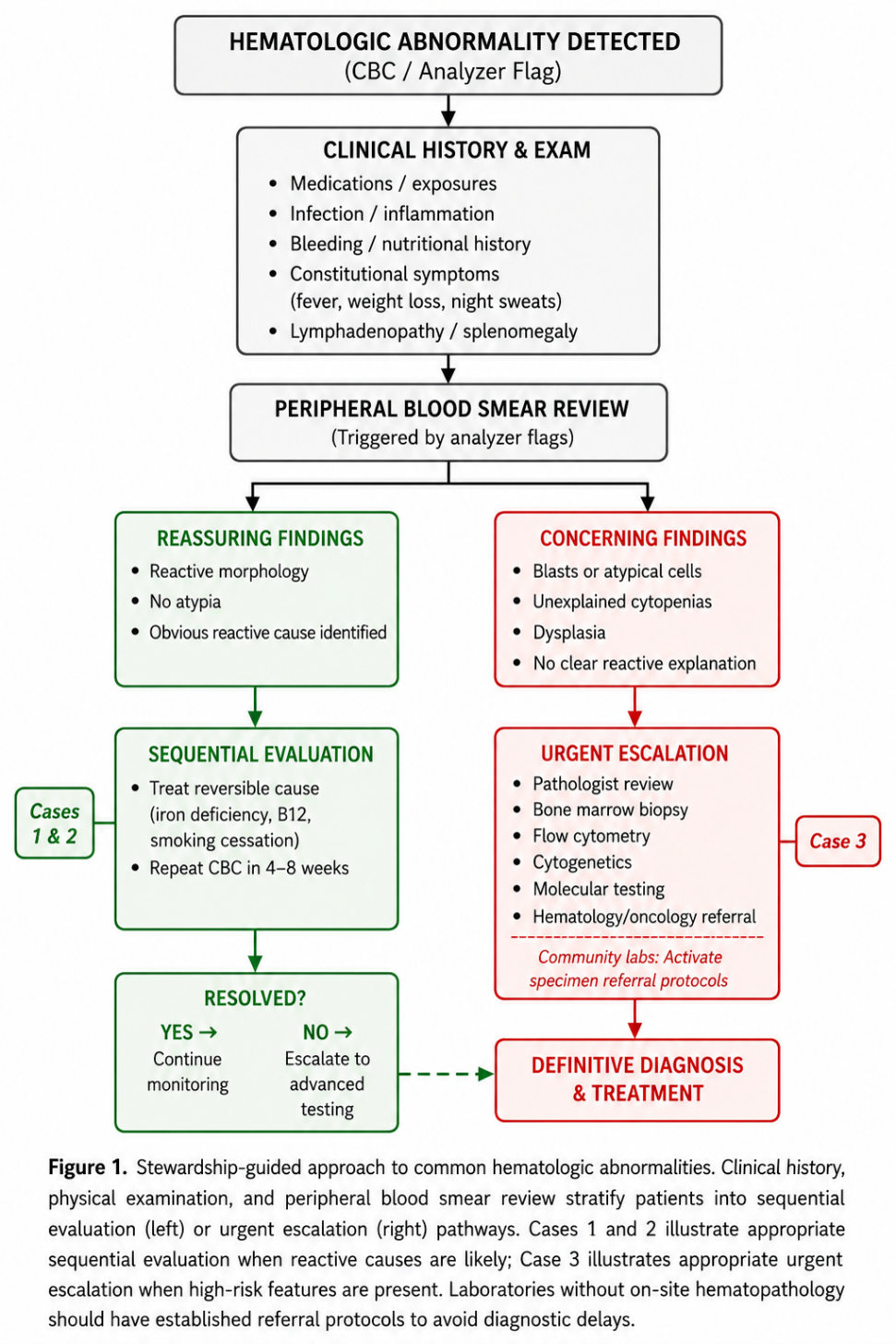
Figure 1 illustrates a stewardship-guided framework for stratifying hematologic abnormalities into sequential evaluation or immediate escalation pathways based on clinical risk. The diagnostic pathway selected is contingent on the resources available in the healthcare setting. Although the availability of specialty testing directly influences both the sequence and speed of evaluation, clinicians should embrace a stepwise approach based on the pretest probability of disease.
Figure 1: Stewardship-guided approach to common hematologic abnormalities
Unnecessary testing can cause substantial psychological distress among patients and also increase their risk of iatrogenic complications (1). These issues are particularly concerning for individuals with benign conditions who will not derive any clinical benefit.
Laboratorians have an opportunity to lead test stewardship by defining smear-review criteria, implementing reflex testing, adding interpretive comments, and developing clinical decision-support tools.
Conclusion
The goal of stewardship is not fewer tests but appropriate diagnostic intensity. The Goldilocks principle applies here: Use the right test for the right patient at the right time in the right setting.
References
- Pfeffer MA, Martens K, Kartika T, et al. Psychological toxicity in classical hematology. Eur J Haematol 2023;111:523-35.
- Jackups R, Szymanski JJ, Persaud SP. Clinical decision support for hematology laboratory test utilization. Int J Lab Hematol 2017;39:7-14.
- Smith CJ, Kluck LA, Ruan GJ, et al. Leukocytosis and tobacco use: An observational study of asymptomatic leukocytosis. Am J Med 2021;134:100-4.
- Tefferi A, Gangat N, Loscocco GG, et al. Essential thrombocythemia: A review. JAMA 2025;333:701-14.
- de Haas V, Ismaila N, Advani A, et al. Initial diagnostic work-up of acute leukemia: ASCO clinical practice guideline endorsement of the College of American Pathologists and American Society of Hematology guideline. J Clin Oncol 2019;37:239-53.
Sanjai Nagendra, MD, MMM, is a medical director at Labcorp Center for Esoteric Testing and Atlantic Regional Laboratories in Burlington, North Carolina. +EMAIL: [email protected]
Supported By