
By Jacqueline Hubbard, PhD, DABCC (CC, TC)
Published in the September 2026 issue of Clinical & Forensic Toxicology News
Introduction
Imagine picking up a small tuft of fur from the ground only to discover that you have touched one of the most venomous caterpillars in North America! Despite its deceptively soft appearance, Megalopyge opercularis is capable of producing immediate, severe pain and a characteristic rash following contact with its hidden venomous spines. Owing to its furry appearance and painful sting, the caterpillar is known by many common names, including the puss caterpillar, asp, woolly asp, opossum bug, woolly slug, and el perrito (“the little dog”) (1–4).
M. opercularis is the most widely distributed venomous caterpillar in the Americas and is endemic to the southern United States (3). Human exposure is common because the caterpillar frequently inhabits shade trees and ornamental shrubbery in residential neighborhoods, parks, schools, and other populated areas (1). Thousands of envenomations occur annually, yet many individuals are unaware that the caterpillar is venomous or that contact has even occurred until symptoms develop. Consequently, the abrupt onset of severe pain often leads to anxiety, confusion, and the need for medical evaluation. Despite the frequency of exposures, many healthcare professionals remain unfamiliar with the clinical presentation, toxicology, and public health significance of M. opercularis envenomation (1).
General characteristics
The order Lepidoptera, which includes moths and butterflies, comprises approximately 160,000 species worldwide and represents one of the largest orders of insects (3). Although most species are harmless to humans, a small subset possesses venomous defenses that can result in clinically significant poisonings. More than 50 species of caterpillars in the United States are known to cause toxic reactions, making caterpillar exposure one of the most common forms of arthropod envenomation encountered in certain regions of the country (3, 4). Most medically important exposures occur during the larval stage, when urticating hairs or venomous spines function as defensive structures against predators. Consequently, caterpillars account for the overwhelming majority of clinically significant human interactions with Lepidoptera. M. opercularis belongs to the family Megalopygidae, commonly known as the flannel moths, a group distinguished by dense hair-like coverings that conceal venomous spines beneath the body surface (5).
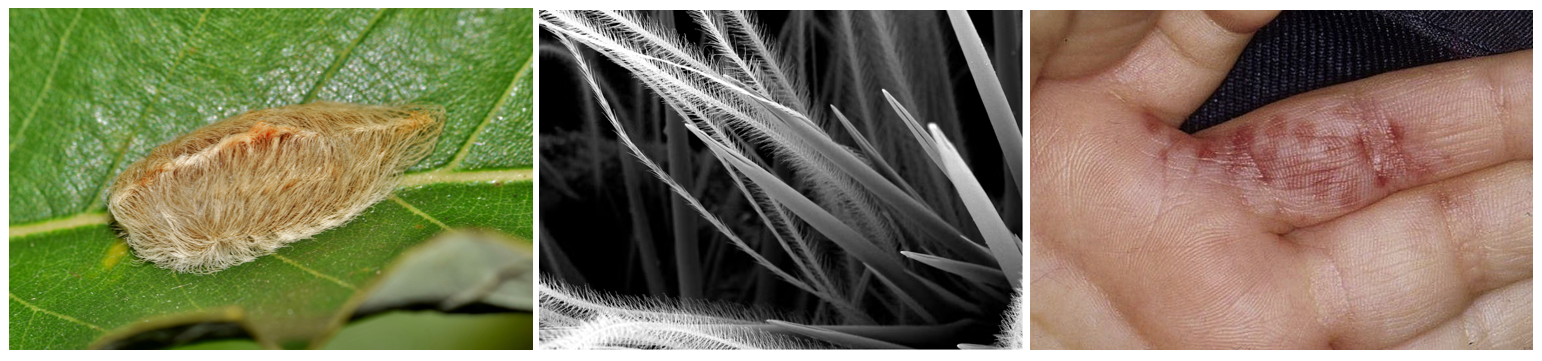
The mature caterpillar is typically 1–1.5 inches (2.5–4 cm) long and has a distinctive teardrop-shaped body (Fig. 1A). Coloration varies considerably and may range from white and gray to tan, yellow, or reddish-brown (1, 3). Dense silky hairs cover the entire body and conceal rows of hollow venomous spines arranged in parallel rows along the dorsum of the caterpillar (Fig. 1B) (3, 4). The conspicuous hairs are nonvenomous, whereas the shorter underlying spines function as the venom-delivery structures. Anatomical studies have shown that venom is produced by specialized secretory cells located beneath the cuticle, which are connected to the hollow venom spines through canals that terminate in a bulb-like basal reservoir associated with each spine (6). When the caterpillar is disturbed, the spines penetrate the skin and release venom stored within the spine lumen and basal reservoir; detached spines may remain embedded in the skin and continue to deliver venom after contact. The venom allows the caterpillar to avoid predation and potentially inhibit apoptosis, resulting in improved cellular longevity (7).
The venom of M. opercularis is dominated by a family of 29 to 32 kDa proteins termed “megalysins” due to their similarity to the bacterial toxins of the aerolysin family (6). It is hypothesized that these toxins, which are primarily responsible for the envenomation of M. opercularis, were acquired via horizontal gene transfer from bacterial ancestors of the ditrysian Lepidoptera (6). Other proteins in the venom include pheromone/odorant-binding proteins, cysteine-rich secretory proteins, hyaluronidase, melanization, and immune-associated enzymes, as well as a smaller complement of low-molecular-weight peptides (6). Functionally, these toxins permeabilize cellular membranes by forming pores that promote calcium influx and direct activation of mammalian sensory neurons, producing the intense pain, erythema, and edema characteristic of its sting (6, 7). In addition to its algogenic effects, the hemolymph and spine setae extracts of M. opercularis exhibit potent pro-inflammatory activity by stimulating IL-1β, IL-6, IL-8, and TNF-α in human peripheral blood mononuclear cells and pro-coagulant effects by reducing clotting time in human plasma (7). The venom also displays cytotoxic activity against murine lymphoma cells through the induction of apoptosis, highlighting the diverse biological activities of its toxin repertoire. Overall, M. opercularis venom is distinguished from other characterized lepidopteran venoms by its predominance of horizontally acquired aerolysin-like pore-forming toxins and its highly effective pain-inducing mechanism based on direct membrane disruption and neuronal activation (6).
M. opercularis undergoes complete metamorphosis and typically produces two generations each year. Caterpillars overwinter within cocoons attached to twigs and branches. Adult moths emerge in late spring, mate, and deposit eggs on the leaves of host trees and shrubs (1, 3, 5). Eggs hatch within 4–8 days, producing a new generation of larvae (5). Consequently, human exposures generally follow a bimodal pattern, with a smaller peak occurring during June and July and a larger peak during September through November (1, 3).
Graphical distribution and public health impact
M. opercularis is distributed throughout the southeastern and south-central United States, with the greatest concentration of reported cases occurring in Texas, followed by Louisiana and Florida (1). Although most commonly associated with Gulf Coast states, exposures have been reported as far west as Arizona and as far northeast as Maryland, indicating a broader geographic distribution than generally recognized (1, 3).
Given its widespread distribution and tendency to inhabit residential and recreational areas, human exposure is common. A retrospective review of Texas Poison Center data identified 3,484 reported envenomations over 17 years, with the majority occurring at private residences. However, exposures have also been reported in schools, public spaces, and workplaces, reflecting the close proximity of M. opercularis to human environments (2).
While most cases are self-limited, infestations occasionally reach public health significance. Historical outbreaks in Texas have resulted in temporary school closures because of concerns regarding widespread exposure (4). Emerging evidence also suggests that environmental modification may influence caterpillar populations. In one Houston study, exclusion of avian predators from tree canopies increased M. opercularis abundance by more than 7,300%, potentially increasing opportunities for human exposure in urban environments (10).
Clinical manifestation
The hallmark of M. opercularis envenomation is the rapid onset of severe, intense pain following contact. Patients frequently describe the sensation as burning, throbbing, or pain comparable to blunt-force trauma or a fractured bone (1, 4, 10). Pain typically develops immediately and may radiate proximally along the affected extremity. Within minutes, erythema and edema begin to develop at the contact site, followed by the appearance of erythematous or hemorrhagic papules arranged in a characteristic grid-like pattern corresponding to the distribution of embedded spines (Fig. 1C) (1–4).
Clinical presentation varies widely among individuals. Most cases are limited to localized pain and dermatitis, but systemic symptoms may also occur and occasionally mimic more serious medical conditions (1–3, 5). Reported manifestations include:
- Intense pain, often radiating beyond the sting site
- Burning, stinging, or pruritus
- Erythema and edema
- Headache
- Fever
- Nausea and vomiting
- Abdominal pain
- Lymphadenopathy or lymphadenitis
- Chest pain
- Numbness
- Visual disturbances
- Respiratory distress, shock, or seizures (rare)
- Anaphylaxis (rare)
Most systemic symptoms resolve within several hours, whereas cutaneous findings may persist for several days. More severe or prolonged symptoms may occur following extensive exposure or larger venom doses (3).
Diagnosis is primarily clinical and relies on recognition of the characteristic rash, severe pain, and a history of probable exposure (3). No laboratory test currently exists to confirm M. opercularis envenomation. Clinical laboratories may become involved when systemic symptoms prompt evaluation for alternative diagnoses. For example, patients presenting with chest pain frequently undergo cardiac biomarker testing, while those with severe abdominal pain may undergo extensive laboratory and imaging evaluations before the correct diagnosis is recognized. Routine laboratory findings are generally non-specific.
Treatment
Treatment of M. opercularis envenomation is largely supportive because no antivenom is currently available. Initial management focuses on removal of retained spines and symptomatic relief. Adhesive tape is commonly applied to the affected area and repeatedly removed to extract embedded spines (1, 2). The area should then be thoroughly cleansed and irrigated. Additional treatments include ice packs, oral antihistamines, topical or systemic corticosteroids, hydrocortisone cream, calamine lotion, baking soda preparations, and analgesics as needed (1–3). Most patients can be managed outside of healthcare facilities and recover without complications. In severe cases, calcium gluconate has been reported to relieve pain and muscle spasms, while anaphylactic reactions were treated according to standard protocols, including epinephrine administration when indicated (3).
Conclusion
M. opercularis is an important but underrecognized cause of envenomation in the southern United States. Although most exposures result in localized pain and dermatitis, systemic manifestations may mimic serious medical conditions and prompt extensive diagnostic evaluation. Diagnosis depends on clinical recognition and exposure history, as no confirmatory laboratory tests currently exist. Management is supportive and focuses on removal of retained spines and symptomatic treatment. Increased awareness among clinicians and laboratorians, coupled with continued research into venom composition and pathophysiology, will improve recognition and management of this medically important species.
References
1. Eagleman DM. Envenomation by the asp caterpillar (Megalopyge opercularis). Clin Toxicol (Philadelphia, Pa) 2008;46:201–5.
2. Forrester MB. Megalopyge opercularis caterpillar stings reported to Texas poison centers. Wilderness Environ Med 2018;29:215–20.
3. Estrella M, Elston D. What’s eating you? Megalopyge opercularis | MDedge. Cutis 2020.
4. Hossler EW. Caterpillars and moths. Dermatol Therapy 2009;22:353–66.
5. Lucas TL. Poisoning by Megalopyge Opercularis (“Puss Caterpillar”). JAMA 1942;119:877–80.
6. Walker AA, Robinson SD, Merritt DJ, et al. Horizontal gene transfer underlies the painful stings of asp caterpillars (Lepidoptera: Megalopygidae). Proc Natl Acad Sci U S A 2023;120:e2305871120.
7. Orozco-Flores AA, Valadez-Lira JA, Covarrubias-Cárdenas KE, et al. In vitro antitumor, pro-inflammatory, and pro-coagulant activities of Megalopyge opercularis J.E. Smith hemolymph and spine venom. Sci Rep 2020;10:18395.
8. Walker A. The furry puss caterpillar’s venom packs a painful punch. Now new research shows it came from an unlikely source. The Conversation. 10 July 2023. https://doi.org/10.64628/AA.gjartspd4
9. Hossler EW. Caterpillars and moths: Part II. Dermatologic manifestations of encounters with Lepidoptera. J Am Acad Dermatol 2010;62:13–28. https://doi.org/10.1016/j.jaad.2009.08.061
10. Hood GR, Comerford M, Weaver AK, et al. Human-mediated disturbance in multitrophic interactions results in outbreak levels of North America’s most venomous caterpillar. Biol Lett 2019;15:20190470.
Jacqueline Hubbard, PhD, DABCC (CC, TC) is the Director of Chemistry and Director of Toxicology at Beth Israel Deaconess Medical Center and Assistant Professor of Pathology at Harvard Medical School in Boston, MA.
The author has nothing to disclose.