Scientific Shorts are brought to you by the

Diagnosing pancreatic ductal adenocarcinoma (PDAC) before it can metastasize is key to improving its current 13% 5-year survival rate. Early diagnosis significantly increases pancreatic cancer survival, but only 1 in 5 are diagnosed when surgery is an option. Diagnostic imaging technologies have limitations in detecting early-stage tumors, and no biomarkers are approved for PDAC diagnosis. With the goal of developing a 2-6 biomarker model, a model development study was undertaken using a set of ten biomarkers that were the result of a multiplex proteomics study of 2261 biomarkers querying stage 1 and 2 PDAC against healthy and at-risk controls1,2. Mann-Whitney U tests were used to evaluate the relationship between individual biomarkers and PDAC status. A 5-plex serum biomarker signature that detected Stage 1 and 2 PDAC with 85% sensitivity at 98% specificity in a cohort of diagnosed patients and genetic/familial high-risk controls was the result of the training of generalized linear models with embedded feature selection that included all possible 2-6 biomarker combinations using PDAC diagnosis as the binary outcome2. This signature is comprised of tissue inhibitor of metalloproteinases 1 (TIMP1), intracellular adhesion molecule 1 (ICAM1), cathepsin D (CTSD), and thrombospondin 1 (THBS1), which are measured using ELISA assays, and carbohydrate antigen 19-9, measured on a Roche Cobas instrument.
The individual protein biomarker assays were analytically validated in a comprehensive validation study which included precision (4 replicates of each of three QC levels daily for 20 days (n > 80 per level)), linearity, matrix effect/parallelism, hook effect, analytical specificity, interference, refrigerator, room temperature, and freeze-thaw stability, ruggedness (operator, time of day, critical reagents), solution stability, limit of blank, limit of detection, preliminary long-term stability and algorithmic error.
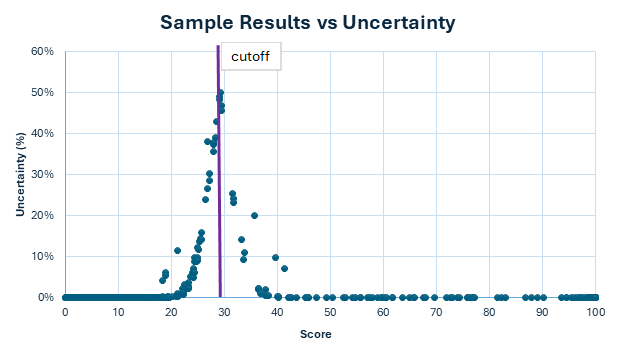
To determine the potential error in the final result, each sample in a 1,066 clinical validation cohort consisting of Stage 1 and 2 PDAC samples and high-risk controls was evaluated using a Monte-Carlo analysis in which the individual error of each biomarker determined in the analytical validation was used to generate 1000 individual random permutations of results from each sample, and calculate the algorithm score output for each. The standard deviation of the algorithm output for each sample was calculated from these permutations to determine the percent chance that the numerical score would cross the cutoff between positive and negative.
This technique gives a much more comprehensive analysis beyond measuring multi-day imprecision using a select number of samples around the cutoff, which in this case was not possible due to rarity of pancreatic cancer samples with sufficient volume to perform a multi-day analysis. Ultimately, this technique estimated only 2% of the samples had more than a 20% chance of crossing the cutoff, showing that the 5-biomarker signature, now known as PancreaSure, can assess the PDAC status of a patient with high accuracy and precision.
*Conflict of interest statement: Author is an employee of Immunovia, Inc*