
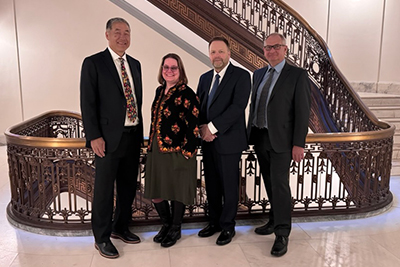
The Association for Diagnostics & Laboratory Medicine (ADLM) held a congressional briefing on Wednesday, February 2 that highlighted several ways that Congress can improve the quality of care provided to the United States’s 73 million children.
Danyel Tacker, PhD, DABCC, FADLM, clinical professor at West Virginia University Hospitals, highlighted the importance of newborn screening (NBS), which helps ensure that babies with rare but treatable conditions receive necessary testing. Congress can play a vital role in newborn screening by continuing to provide stable funding for this highly successful federal-state initiative.
Stanley F. Lo, PhD, DABCC, FADLM, pathology professor at the Medical College of Wisconsin, described the need for more accurate pediatric reference intervals (PRIs), which help physicians interpret test results and diagnose whether a child has a particular medical condition. Currently, most PRIs are based off of adult reference intervals, which can lead to misdiagnosis, inappropriate interventions, and increased healthcare costs. Congress has asked the Centers for Disease Control and Prevention (CDC) to develop a framework for addressing this issue.
Hubert Vesper, PhD, director of Clinical Standardization Programs at the CDC, discussed how the agency can use its existing infrastructure — without creating any new programs — to develop better PRIs. More than 50 healthcare groups, including ADLM, the American Academy of Pediatrics, and the Children’s Hospital Association, have endorsed providing the CDC with the funding needed to improve these intervals.
Lastly, Dennis J. Dietzen, PhD, DABCC, FADLM, Megan Dishop Chair of Pathology and Laboratory Medicine at Phoenix Children’s Hospital, discussed the critical role that laboratory developed tests (LDTs) play in meeting the testing needs of children. He stated that the congressionally mandated CLIA standards continue to provide the flexible, but rigorous oversight needed to serve pediatric patients.