

Navigating genetic testing preauthorization and order triage can be challenging for healthcare institutions. In addition to understanding insurance requirements, lab leaders and other healthcare professionals must manage an increasing number of genetic tests, track rapidly changing molecular methodologies and ordering providers, and ensure clinical teams have access to specialist support as needed.
For more than 15 years, multidisciplinary experts at the Ann and Robert H. Lurie Children’s Hospital of Chicago (Lurie Children’s) have worked together to create an integrated approach to genetic testing stewardship. By sharing key insights and recommendations from our experience, we aim to help those at other institutions looking to optimize their own genetic testing processes.
Establishing an advocacy team
Our hospital’s early efforts to centralize support for genetic testing included the development of The Genetic Testing and Counseling (GTAC) Support Center within Lurie Children’s Center for Genomics. This group includes a diverse team of laboratory directors, genetic counselors, clinicians from both genetics and nongenetics divisions, pharmacists, and finance and compliance professionals. The GTAC Support Center’s strategic pillars include laboratory stewardship, laboratory test interpretation and reporting, and clinical genetic counseling and education.
The laboratory stewardship team within the GTAC Support Center acts as a liaison between ordering providers, clinical laboratories, and various departments — including pathology, finance, and financial clearance. Because the team is well versed in clinical genetics, laboratory genetics, and insurance and billing practices, they provide guidance to healthcare providers through a dedicated hotline, emails, and a digital-communication hub within the Epic electronic medical record (EMR) system. Using a variety of methods and platforms, the stewardship team ensures that all questions about ordering and documentation are addressed promptly, facilitating a proactive approach to effective genetic test utilization.
In addition, the stewardship team educates providers on the latest test options, methodologies, and insurance authorization processes. The team uses an internal, institution-wide website to share practice guidelines, policy documents, and template letters of medical necessity. Capitalizing on EMR functionality that routes pending orders to the stewardship team, team members also review all outpatient genetic test orders for appropriateness, optimal test and reference lab choice, and accurate billing codes.
These efforts have optimized and standardized genetic testing practices within our institution. The centralized nature of the GTAC Support Center ensures that genetic test stewardship is managed consistently, regardless of the clinical department requesting the test.
Recommendation: Consider establishing a centralized stewardship team to manage genetic testing workflows within your healthcare institution. Streamline their work via EMR technology.
Enhancing efficiency with integrated teams
To further bolster stewardship, healthcare leaders within Lurie Children’s strategically positioned genetic counselors in various clinical departments that have high volumes of genetic test orders. These include neurology, cardiology, ophthalmology, oncology, and endocrinology. Importantly, these embedded genetic counselors are current or former members of the stewardship team or prior participants in training programs with the team.
By distributing Lurie Children’s genetic counseling resources across specialties, more clinicians have access to expert guidance regarding test selection and interpretation. This decentralized, yet coordinated, approach fosters a collaborative environment that supports both optimal test utilization and preauthorization compliance. The use of crossfunctional organizational structure minimizes variability and supports consistent application of stewardship protocols.
Recommendation: Integrate genetic counselors with foundational knowledge of laboratory stewardship within specialty patient care teams while maintaining centralized management.
Centralizing preauthorization efforts
Navigating insurance requirements for genetic testing can be complicated. To address this, our hospital’s finance department designated a team within the financial clearance group to manage the preauthorization workflow for all genetic tests ordered across the institution. By integrating specialized knowledge within the financial clearance function, Lurie Children’s enhanced communication and collaboration between the stewardship team and clinicians. More broadly, centralizing the preauthorization process alleviated the need for all providers to navigate insurance authorization portals and processes related to genetic testing.
Recommendation: Establish a centralized preauthorization team with specialized knowledge in genetic testing.
Maximizing automation within the EMR and beyond
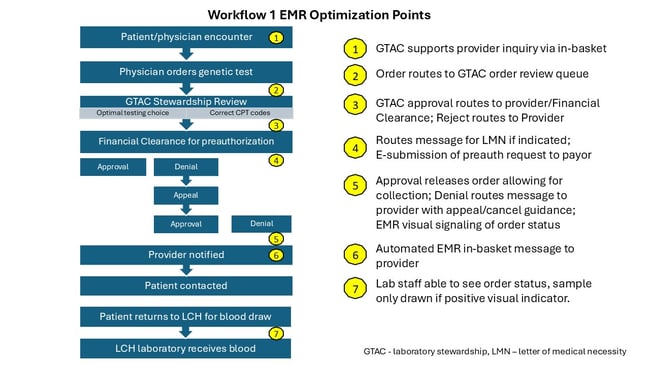
Automation through the EMR has been fundamental to Lurie Children’s success in genetic test stewardship and insurance authorization. We use electronic workflows for laboratory stewardship, preauthorization communication, preauthorization request routing, preauthorization status visual signaling, and order status communication. The automation tracks and documents the entire journey from order to utilization review to preauthorization submission to final determination and ensures that all stakeholders are promptly informed every step of the way.
In recognition of the complexity of the circumstances under which genetic tests are ordered, Lurie Children’s developed a flexible system that allows for multiple workflows depending on the test ordered.
Workflow 1: To minimize insurance denials, high-cost genetic tests that are billed institutionally require laboratory stewardship review and preauthorization approval prior to sample collection. Once approved, the EMR updates the order status with a visual indicator, signaling that sample collection and testing can proceed.
Workflow 2: To maximize efficiency, tests that are not institutionally billed and thus do not require preauthorization (for example, third-party or sponsored tests) undergo laboratory stewardship review, but bypass the financial clearance team.
Workflow 3: To prevent critical diagnostic delays, orders for urgent somatic testing, such as somatic oncology tests and panels, bypass laboratory stewardship but route to the preauthorization team. In these cases, preauthorization is conducted concurrently with sample collection and testing.
Workflow 4: Pharmacogenomic testing follows the required laboratory stewardship and preauthorization process as outlined in Workflow 1, with review by a pharmacist specializing in pharmacogenomics as opposed to the laboratory stewardship team.
Lastly, Lurie Children’s has developed user-friendly business analytics tools to assess the effectiveness of our laboratory stewardship and preauthorization efforts. The hospital utilizes these tools to monitor the workflows, highlight any issues needing attention, and support ongoing improvement.
Recommendation: Use systems to their fullest capacity, incorporating automation for efficiency and improved coordination between clinical and administrative teams. Design digital processes that allow for flexibility and variation among various testing scenarios. Develop analytics tools to monitor efforts and identify areas for improvement.
Looking ahead
Lurie Children’s continues to innovate by exploring machine-learning applications that predict the likelihood of insurance coverage and automate the documentation of medical necessity. Future developments might include incorporating predictive analytics to reduce claim denials and refining Epic’s automation features to perform real-time insurance verification.
Recommendation: Invest in emerging technologies to predict coverage outcomes and integrate advanced data analytics into preauthorization workflows.
Conclusion
By adopting a structured, technology-driven approach to genetic test stewardship, Lurie Children’s has reduced administrative burdens, improved patient care, and promoted financial sustainability.
Katrin M. Carlson Leuer, PhD, is the scientific director of the Cytogenetics Laboratory at Ann and Robert H. Lurie Children's Hospital of Chicago.
Elizabeth Leeth, Jaime Duncan, and Krystal Fernandez are certified genetic counselors who serve on the GTAC lab stewardship team. +EMAIL: [email protected]
Supported By