
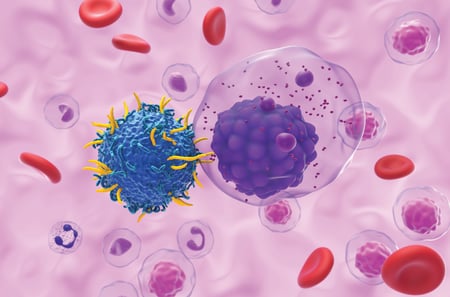
FDA issues draft guidance on MRD in multiple myeloma drug trials
The Food and Drug Administration (FDA) in January issued draft guidance on using minimal residual disease (MRD) and complete response as primary endpoints in clinical trials of drugs and biologics for multiple myeloma (MM), with the goal of their accelerated approval. Diagnostic companies that produce MRD tests expect this guidance to positively affect their businesses as more clinical trials make use of their tests.
Intended to provide new, more sensitive options for efficacy assessments, FDA’s draft guidance gives specific recommendations for designing such trials. In issuing the guidance, FDA acknowledged that prior accelerated approvals that used overall response rate as an endpoint already have surpassed high bars for response. Meanwhile, future trials require increasingly more patients to demonstrate statistically significant improvements in overall response rates, the draft guidance said.
The guidance defines MRD and the MRD negativity rate in bone marrow, determined with flow cytometry or next-generation sequencing for patients who have already achieved a complete response.
After an FDA-pooled analysis of data that analyzed the relationship between MRD and long-term outcomes, the FDA’s Oncologic Drugs Advisory Committee in 2024 accepted MRD as an endpoint for accelerated approval of drugs or biologics for MM patients. The FDA had previously released general recommendations for industry on using MRD in developing drug and biological products for treating patients with blood cancers.
Companies with products that are granted accelerated approval using MRD or complete response as endpoints still must verify clinical benefit via progression-free or overall survival, the draft guidance said.
Survey shows EU regulations affected medical device investment
More than half of medical device companies in the European Union (EU) have reduced their product portfolios to cope with the complexities of EU Medical Device Regulation (MDR) and In Vitro Diagnostic Regulation (IVDR), a study conducted for the European Commission by the consultancy EY found.
The research, which was conducted between 2023 and 2024, showed that 17% of medical device companies have stopped producing devices entirely because of high certification costs and administrative burden. The study’s goal was to identify the key benefits and challenges associated with the MDR and IVDR regulatory governance structure and to examine how these regulations affect innovation and patient safety. The findings were based on an online survey with 470 respondents, 41 targeted interviews, four workshops, three stakeholder consultation workshops, and a benchmarking exercise.
In December 2025, the European Commission proposed a new regulation to streamline the regulatory pathway for medical devices.
FDA approves Cepheid’s fast GI panel
Cepheid recently announced that it has received Food and Drug Administration clearance for Xpert GI Panel, a multiplex PCR test designed to provide fast and accurate detection of 11 clinically relevant gastrointestinal (GI) pathogens from a single patient sample.
The test simultaneously detects and identifies important bacterial, viral, and parasitic pathogens directly from stool specimens in Cary-Blair transport medium. The streamlined workflow requires less than 1 minute of hands-on time and delivers results in approximately 74 minutes, Cepheid said.
The test runs on Cepheid’s GeneXpert systems equipped or upgraded with 10-color modules, which enable simultaneous detection of 10 or more pathogens or biomarkers.
Sequencing platform gets European approvals
Oxford Nanopore Technologies’ GridION Dx is now both U.K. Conformity Assessed and CE-marked, the company recently announced.
The GridION Dx is a compact, scalable sequencing platform designed specifically for diagnostic applications. It leverages proprietary Oxford Nanopore technology to enable real-time, long-read sequencing of DNA and RNA.
GridION Dx’s first application will be infectious disease characterization. The first product, available in partnership with bioMérieux, will integrate with AmPORE-TB, a multidrug-resistant, research only tuberculosis assay. This test is on a defined pathway towards becoming a fully regulated in vitro diagnostics (IVD) assay on GridION Dx, Oxford Nanopore said.
These developments make GridION the company’s first IVD device registered in the United Kingdom and Europe, set up Oxford Nanopore for future adoption in regulated clinical markets, and reflect the company’s long-term commitment to sequencing-based diagnostics, Oxford Nanopore said.
Hologic introduces digital pathology capabilities with expanded CE marking
Hologic recently announced that its Genius Digital Diagnostics System has achieved expanded CE marking in the European Union.
Now approved for whole slide imaging for review of both cell and tissue specimens, the system enables imaging of a broader range of patient sample types.
Genius Digital Diagnostics System allows labs to capture high-quality digital images of cell and tissue specimens and digitize, store, distribute, and review them on a single platform. In contrast, most laboratories rely on multiple systems for review of different patient sample types. This separation can create inefficiencies for the lab, increase operational costs, extend turnaround times, and create additional work for lab staff.
Automated insulin delivery algorithm in app gets FDA 510(k) clearance
Diabeloop has received Food and Drug Administration (FDA) 510(k) clearance for its DBLG2 application as a Class II interoperable automated glycemic controller.
The app is available for Android and iOS and pairs with a continuous glucose monitor (CGM). Designed to automate and personalize insulin delivery for patients with type 1 diabetes, the app analyzes glucose data in real time and adjusts insulin delivery to maintain blood sugar levels within an optimal target range.
DBLG2 has a self-learning module that applies improvements to the patient’s algorithm para-meters based on estimated glycemia history and insulin delivery quantities from the patient’s history.
The clearance and interoperability status positions Diabeloop as a central player in the global diabetes ecosystem and opens the door to multiple launches in the United States in 2026 and 2027, the company said. It added that the FDA has also approved the Diabeloop Predetermined Change Control Plan, a mechanism that allows the company to evolve its device according to a preestablished protocol for integrating new pumps or CGMs that conform to FDA requirements, without having to resubmit a 510(k) filing.