

The primary financial goal of laboratory stewardship is to achieve financial alignment between patients, labs, and payers. Reaching this goal involves cultivating a shared understanding of medical necessity. When all parties are aligned financially, patients are protected from financial toxicity, labs are paid fairly for medically necessary testing, and insurance companies do not pay for fraud, waste, quackery, or abuse.
Our previous work published by the Association for Diagnostics & Laboratory Medicine, which is based on findings from PLUGS (Patient-Centered Laboratory Utilization Guidance Services) and PLUGS collaborators, focused on the perspectives of payers and patients (1,2) and explored medical necessity policies (3), the revenue cycle (4), and other topics.
In this article, we highlight clinical laboratory perspectives on financial fairness.
Table 1 shows a consensus list of what clinical laboratory leaders desire regarding financial fairness from payers.
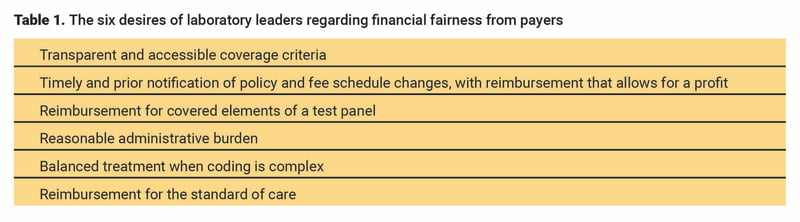
Transparent and accessible coverage criteria. Laboratories need access to clear, comprehensive coverage policies that address medical necessity and administrative policies that cover payable ICD-10 codes, prior authorization requirements, and bundling rules. These policies should be readily available to ensure timely filing, fair claim adjudication, and informed test ordering. When applicable, laboratories should be informed about which third-party vendors their payers are using for payment integrity or lab benefits management.
Timely and prior notification of policy and fee schedule changes, with reimbursement that allows for a profit. Laboratories should be notified in advance of any changes to medical policies, claims rules, or fee schedules impacting reimbursement. This includes adjustments to the list of payable or unpayable diagnosis codes for a laboratory service. Sudden or retroactive changes undermine labs’ trust in the fairness of healthcare finance. Moreover, new restrictions on testing have adverse financial consequences for labs. A fair price list is an obvious desire.
Reimbursement for covered elements of a test panel. When a laboratory test includes both covered and noncovered components (e.g., expanded gene panels, autoantibody panels, allergy panels, infectious disease panels), laboratories should receive reimbursement for the medically necessary portion rather than a blanket denial of the entire service.
Reasonable administrative burden. Laboratories should not face disproportionate prior authorization or documentation requirements, especially for low-cost or time-sensitive tests. They should be allowed to submit appeals in bulk when the rationale for the appeals is based on the same or similar issues. Additionally, they should be permitted to submit prior authorization requests on their own behalf; prior authorization requests for laboratory services should not be restricted to the ordering provider.
Given the timeline of laboratory services, and the reality that patients and providers need timely results, prior authorization often is not practical to obtain before performing a medically necessary test (e.g., cancer genomic profiling that determines timely and specific treatment). Therefore, when a service is denied by a payer simply because prior authorization was not obtained, laboratories must have the right to substantiate medical necessity post-service.
Fair treatment in the context of coding complexity. Laboratories should not be penalized for ICD-10 coding conflicts or exclusions, such as “Excludes 1” rules, especially when a test is medically necessary and would be covered by one of the codes. In the context of insurance claims and laboratory testing, an “Excludes 1” note indicates that two specific ICD-10 codes cannot be reported together. In other words, the two conditions are not both reimbursable when they appear on the same claim for the same encounter.
The challenge arises when both an excluded and a payable ICD-10 code appear on the claim. In some cases, this can trigger automated denials for the entire claim, rather than just the relevant procedure in the “Excludes 1” notes. Additionally, the procedure sometimes is denied, even though either of the two codes causing the Excludes 1 edit is clinically appropriate.
For a diagnosis that has not been established yet, and for which lab testing is being used to help determine the diagnosis, payable ICD-10 codes should include the major signs, symptoms, and risk factors related to the diagnosis. The payable ICD-10 codes should not be restricted to codes for specific diseases and syndromes before they have been diagnosed.
Reimbursement for the standard of care. Laboratories deserve payment for tests that align with the standard of care. The standard of care and evidence-based medicine often are in alignment, such that the standard of care is based on strong evidence. This is the case for common conditions such as atherosclerotic cardiovascular disease.
However, in rare diseases and in patients with multiple comorbidities, the standard often is based on weaker evidence (e.g., prospective, observational studies or retrospective studies). In these cases, nuances in clinical practice that align with the standard of care should be reimbursed, and the insurance policies should provide guardrails on practice rather than narrow rules.
By addressing the six desires outlined in this article, payers, providers, and other healthcare professionals can strengthen their relationships with lab leaders and ensure that laboratories are paid fairly.
Michael Astion, MD, PhD, is director of regional laboratories, director of point-of-care testing, and co-director of reference laboratories in the department of laboratories, Seattle Children’s Hospital and a professor of laboratory medicine and pathology at the University of Washington in Seattle. +EMAIL: [email protected]
Acknowledgements: PLUGS member laboratories provided useful feedback to this article.
Read the full March-April 2026 issue of CLN.
References
- Astion ML and Baird GS. Payment matters: Understanding payer perspectives on laboratory stewardship. J Appl Lab Med 2025;10:79-91.
- Astion M and Jackson BR. Patient-centered laboratory stewardship can reduce financial toxicity. CLN 2021; https://www.myadlm.org/CLN/Articles/2021/October/Patient-Centered-Laboratory-Stewardship-Can-Reduce-Financial-Toxicity
- Astion M. Medical necessity policies: Creating opportunities for better test utilization and fair payment. CLN 2023; https://www.aacc.org/cln/articles/2023/julaug/medical-necessity-policies-creating-opportunities-for-better-test-utilization-and-fair-payment
- Astion M and Ibrahim KA. Five concepts about the ambulatory payment system that will help laboratorians gain power and improve patient care. CLN 2025; https://myadlm.org/cln/articles/2025/julyaugust/five-concepts-to-improve-the-ambulatory-payment-system
Supported By