
The Outstanding Scientific Achievements by a Young Investigator Award recognizes and encourages the professional development of a young investigator who has demonstrated exceptional scientific achievement early in their career. This award honors individuals whose work reflects a high degree of originality, creativity, and innovation, and whose research has made a meaningful contribution to the field of clinical laboratory medicine.
Selection is based on the significance and impact of the investigator’s scientific work, as well as the originality demonstrated in the individual’s creative and investigative approach. The award is conferred upon an individual who has shown clear promise and potential to become an outstanding investigator and leader of the future in laboratory medicine.
To be eligible, nominees must not have reached the age of 40 by January 1 of the year in which the award is presented and must be a member of the Association for Diagnostics & Laboratory Medicine.
Congratulations to the 2026 winner
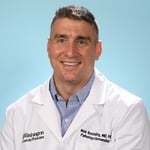 Nicholas Borcherding, MD, PhD
Nick Borcherding, MS, MD, PhD, is a physician-scientist and assistant professor in the department of pathology and immunology at Washington University School of Medicine in St. Louis.
Dr. Borcherding’s work bridges computational immunology, clinical pathology, and transplant immunogenetics. Clinically, his practice focuses on human leukocyte antigen (HLA) testing for transplantation, autoimmunity, and cancer immunotherapy. His research investigates how the adaptive immune system encodes and recalls disease experiences. His research work integrates single-cell sequencing, systems immunology, and machine learning to map immune diversity and predict clinical outcomes. He is active in the field of computational repertoire analysis and developed scRepertoire, one of the first R packages dedicated to the analysis of single-cell immune receptor sequencing data. His current research utilizes innate and adaptive cellular barcodes, including mitochondrial genomes, to trace clonal relationships across tissues.
By combining high-dimensional multiomic data with network topology, Dr. Borcherding aims to develop new diagnostic frameworks to advance laboratory medicine.
Previous Winners
2025 - Nicholas C. Spies, MD
2024 - Mark A. Zaydman, MD, PhD
2023 - Victoria Higgins, PhD, FCACB
2022 - Christopher Farnsworth, PhD, DABCC, FADLM
2021 - Maria Alice Willrich, PhD
2020 - Dina Greene, PhD
2019 - Livia Schiavinato Eberlin, PhD
2018 - Christina Lockwood, PhD
2017 - Mark Marzinke, PhD
2016 - Mari DeMarco, PhD
2015 - Kara L. Lynch, PhD
2014 - Pete A. Kavsak, PhD
2013 - Rossa W.K. Chiu, MBBS, PhD
2012 - Andrew Hoofnagle, PhD
2011 - Linnea Baudhuin, PhD, DABMG
2010 - Amy Saenger, PhD
2009 - Joshua Bornhorst, PhD
2008 - Alex Rai, PhD
2007 - Loralie J. Langman, PhD
2006 - Roshini Abraham, PhD
2005 - Liu-Ying Luo, PhD
2004 - Yaniv Sherer, MD
2003 - George Yousef, MD
2002 - Thomas Daly, MD
2001 - Lynn Bry, PhD
2000 - Sridevi Devaraj, PhD
1999 - Elizabeth M. Rohlfs, PhD
1998 - Uttam Garg, PhD
1997 - Gregory J. Tsongalis, PhD
1996 - Ann Gronowski, PhD
1995 - David Hage, PhD
1994 - Bruce Goldberger, PhD
1993 - Marcie Hursting, PhD
1992 - Bryan Wolf, PhD
1991 - Amitava Dasgupta, PhD
1990 - Thomas Prior, PhD
1989 - Timothy Schroeder
1988 - Nader Rifai, PhD
1987 - Thomas M. Annesley, PhD
1986 - Alan Wu, PhD
1985 - Eleftherios P. Diamandis, MD, PhD
1983 - Daniel Nealon, PhD
1982 - Norman Leigh Anderson, PhD
1981 - Jean-Pierre Bretaudiere
1981 - Stephen Thibodeau, PhD
1980 - Thomas Grove, PhD
1979 - Eric Sampson, PhD
1978 - Robert Rej, PhD
1977 - Herbert K. Naito, PhD
1976 - Lawrence M. Silverman, PhD